Street Names in Hvide Sande
Street names that recall dramatic shipwrecks on the Jutland west coast
Dakota
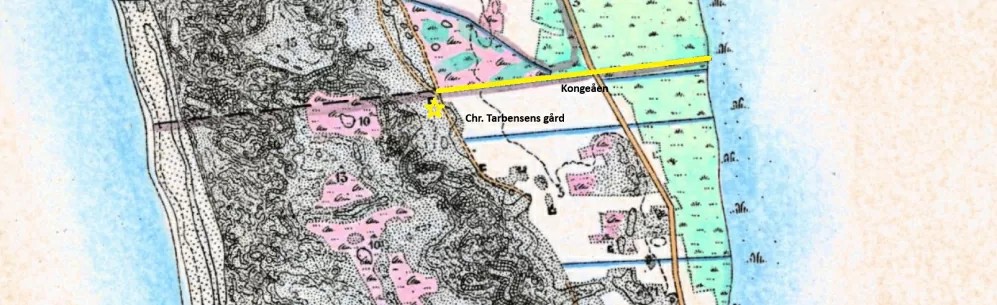
“Dakota” was a full-rigged ship of 1,203 gross tons, built of wood in 1881 by W. Rogers, Bath/Me., and owned by the Ihler shipping company in Bremen.
The ship, captained by M.E. Schaffer, ran aground in Christen Nielsen’s (Klink’s) beach section in Sønder Lyngvig on January 31, 1888.
“Dakota” was on a voyage from Hamburg to Christiania (Oslo), where it was to load building materials for Melbourne, Australia.
The stranding happened early in the morning with offshore winds and snow. Shortly before the stranding, the lookout warned the officer on watch that he could hear surf ahead to starboard, but the officer dismissed it, believing the ship was well clear of the coast. This proved wrong, as “Dakota” soon ran aground and became stuck.
Of the 22-man crew, the captain and one crew member perished; the rest made it ashore on their own.
An excerpt from an old stranding protocol reads: “On January 31, 1888, at 2:30 p.m., the police chief, Mayor Petersen, arrived at beach bailiff Christen Nielsen’s section in Sønder Lyngvig in response to a telegram received at 10:30 a.m. that the full-rigged ship ‘Dakota’ of Bremerhaven had stranded in the said section.”
The hull of “Dakota” was sold around March 5 of the same year to a partnership represented by manufacturer Tang in Holstebro. The hull was later broken up by a storm.
The church ship in Nørre Lyngvig church is said to have been made by merchant Simon Jensen in Sønder Lyngvig. He, who was in a wheelchair, went aboard “Dakota” before it was scrapped to study and draw the ship’s rigging before making the church ship.
Kania
“Kania,” a trawler from Gdynia, Poland, ran aground on November 30, 1953, off Husby church.
The trawler, which ran aground at 4 a.m., had been fishing near England and was on its way home.
It was spotted by the beach watch, Poul Jensen, who saw the ship’s lanterns close to shore. He immediately alerted the rescue station’s supervisor, Chr. Bank, who quickly assembled the rescue crew.
The rescue boat and rocket equipment quickly arrived at the scene, but due to the high seas, the boat could not be used, so the rocket apparatus was employed.
A line was shot out to the ship, and the rescue began. Within an hour, 13 men were brought ashore in the rescue chair, but the captain and three crew members chose to stay on board for the time being. They were later brought ashore as well, as the stormy weather made it impossible to salvage the ship at that time.
It was then left to Svitzer to salvage it. In 1954, “Kania” was towed out again and brought to Aalborg for repairs.
Janna
Jannavej in Hvide Sande is named after the Dutch schooner “Janna” of Middelburg, which ran aground at Haurvig on August 3, 1916.
The ship had a crew of four, three of whom made it ashore using a line thrown from land. The captain was rescued in the rescue chair by the crew from Bjerregaard.
The ship was on a voyage from Rotterdam with old iron bound for Stockholm. “Janna” was later refloated.
Minerva
Minervavej is named after the Dutch “kuf” Minerva of Schiedam, which ran aground at Bjerregaard on November 17, 1860. The crew of four made it ashore on their own.
The cause of the stranding was that the ship sprang a leak at sea, and the captain decided to beach the ship.