The Story of Tyskerhavnen
For many years, there has been speculation about why it is called Tyskerhavnen (the German Harbor). Some say it has to do with the war. Others believe a German once lived there. And then there are those who think it’s about geography. Many explanations have been suggested — but here is the true story, which ties into the history of the dunes and a certain Farmer King.
Back in 1910, the first canal at Hvide Sande was dug through the dunes. But already in 1912, after violent storms, it had become 260 meters wide. The authorities in Copenhagen ordered it closed. Materials for the closure were shipped to the place we now know as Tyskerhavnen. But that’s not the real reason for the name — that comes from another story.
In the mid-1800s, scattered dune farms stretched from Søndervig in the north to Bjerregård in the south. People lived off the land, the fjord, and the sea. It was a simple but hardworking life, where community meant everything.
North of present-day Hvide Sande lived a man called the Farmer King. He was well-liked, quick-witted, and an eager participant when the farmers gathered to play cards. One winter evening, there was a gathering on the southern dune. Cards were played, the coffee punch was strong, and the stories grew taller as the night went on. The Farmer King had a good night — he won some money and drank plenty.
On his way home, feeling good and wrapped in blankets, he lay back in the wagon. The horses knew the way. But as the night grew darker, his eyes grew heavier. The Farmer King fell asleep.
A little north of today’s Tyskerhavnen, a small bridge crossed a ditch. The horses crossed as usual, but the wagon slipped — and the Farmer King ended up in the ditch with a splash.
When he staggered out, soaked, he hoped no one had seen him. But unfortunately, the rest of the farmers, who had also been at the card game, came by soon after. “What are you doing there?” they laughed. The Farmer King had to admit he’d fallen asleep.
He hoped the episode would be forgotten, but in the dunes, as in Hvide Sande today, it doesn’t take much to get a nickname or for something to be renamed — and that’s what happened here.
The story of the Farmer King who ended up in the ditch spread like wildfire. From then on, he was called the Wet King, and the ditch — it was named Kongeåen (the King’s Stream).
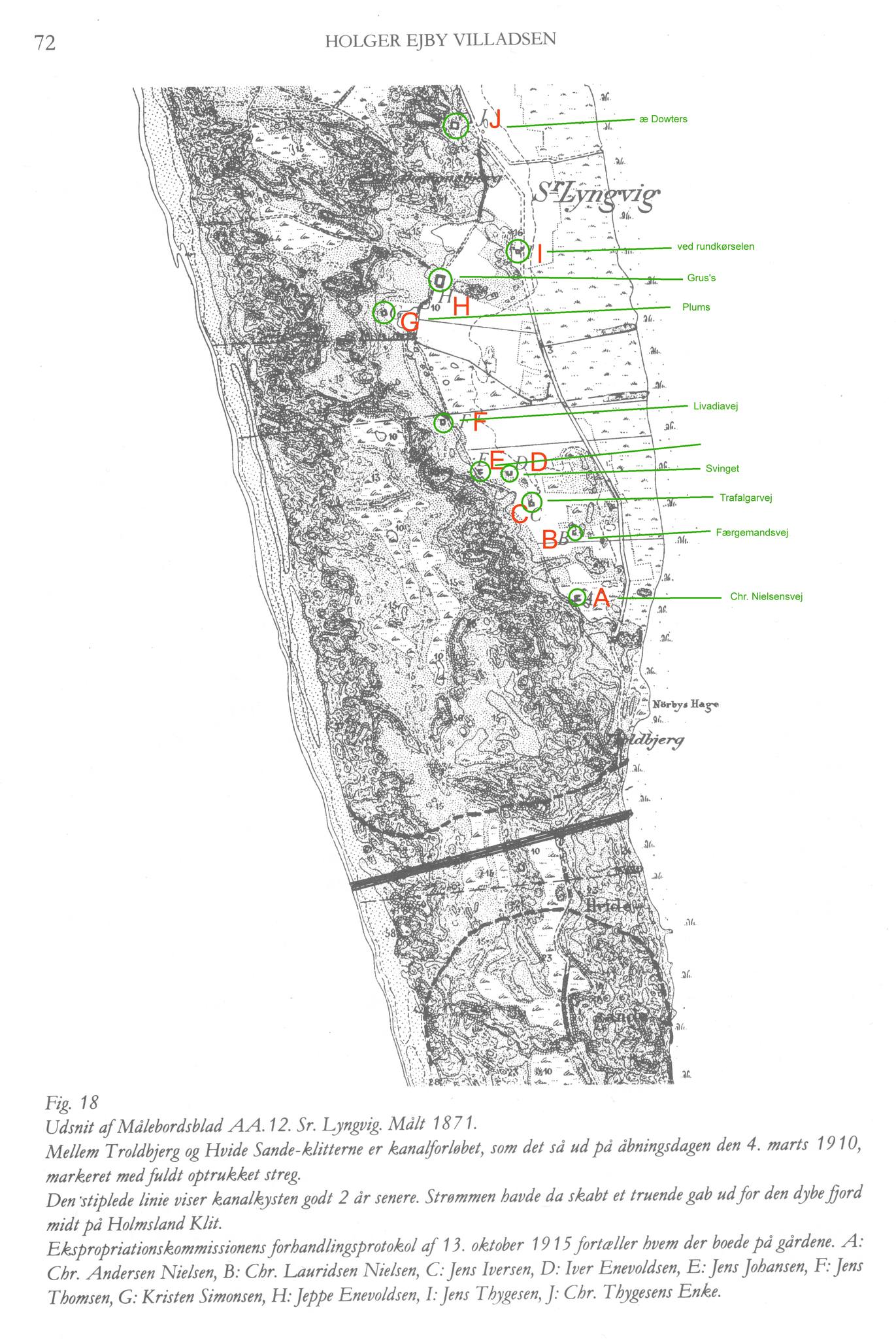
Kongeåen was the boundary ditch north of Jens Thomsen’s farm (later Kristen Tarbensen’s farm, on Apollovej). The area south of Kongeåen was therefore called Germany, and the residents were called “the Germans.”
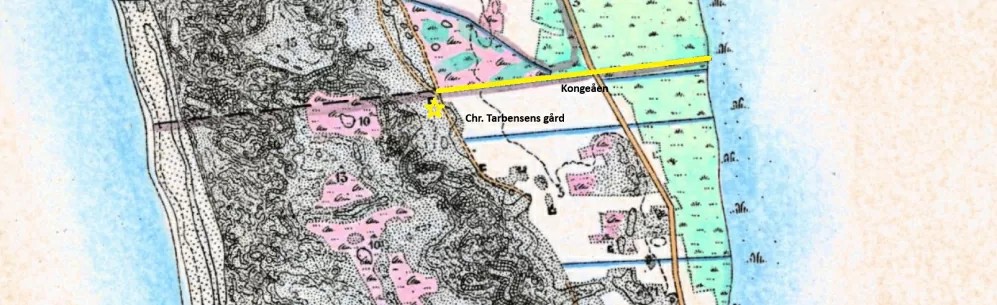
When VBV established the landing site for closing the Hvide Sande canal in 1912, in “Germany,” fishermen from the local farms — the Germans — immediately began using the new landing site.
That’s how the name Tyskerhavnen came to be!
Who were the local fishermen called “the Germans”? In 1915, an expropriation commission was set up to pay compensation to landowners whose land was used for the rail track that brought gravel to the dam works — the Sikring. In the records from that time, we can see who lived on the farms in Sønder Lyngvig and thus who were the original users of Tyskerhavnen.
And that, dear reader, is the true story — which probably hasn’t gotten any worse over time. And that’s no lie.